Comparison·Choosing a tracker
Is your rank tracker enough to track AI Overviews?
A rank tracker is enough when the job is measuring Google AI Overview presence and site visibility for a known keyword set.
·14 min read·Markdown
On this page
- What does AI Overview tracking measure?
- Is a rank tracker enough for AI Overviews?
- Which rank trackers monitor Google AI Overviews?
- How does Semrush AI Overview tracking work?
- Does SE Ranking track AI Overviews?
- What does a dedicated GEO tool add?
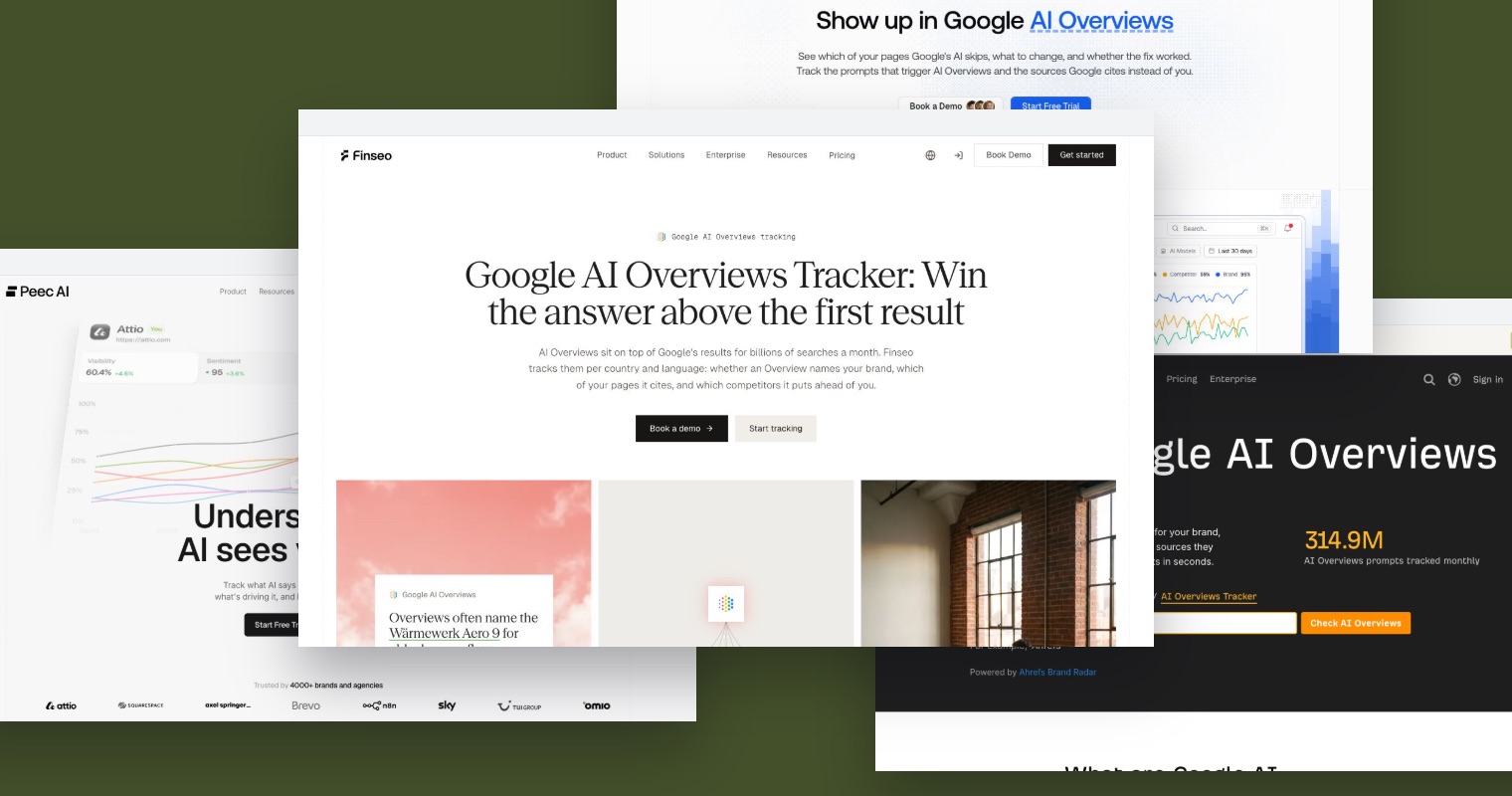
- 1. Finseo — AIO tracking with a broader GEO workflow
- 2. Semrush — AIO visibility inside a mature rank-tracking workflow
- 3. SE Ranking — AIO and multi-engine AI results in one ecosystem
- 4. Nozzle — SERP evidence and citation-position detail
- 5. Ahrefs Brand Radar — Broad AI visibility across engines
- How should teams compare AIO and GEO tools?
- Which tool is right for whom?
- How does AI Overview tracking work in practice?
- FAQ
- Sources
Summarize with ChatGPTClaudePerplexity
TL;DR
- A rank tracker is enough when the job is measuring Google AI Overview presence and site visibility for a known keyword set.[9]
- Semrush, SE Ranking, Ahrefs, STAT, Nozzle, AccuRanker, and SISTRIX expose different levels of AIO visibility, citation, SERP, and competitor data.
- A dedicated GEO layer adds prompt-level monitoring, multiple AI engines, brand mentions, citations, sentiment, competitor framing, and broader source analysis.[1]
- Finseo combines Google AI Overview and AI Mode tracking with other AI engines, cited-source analysis, competitors, sentiment, and market-level visibility reporting.[1]
- Choose the smallest layer that answers the reporting question: rank tracking for Google AIO keywords, and GEO monitoring for cross-engine brand visibility.[9][10]
AI Overview tracking in rank trackers is enough when the question is limited to Google SERP visibility for a known keyword set. A dedicated GEO tool becomes useful when the brief expands to prompt-level monitoring, multiple AI engines, cited-source analysis, brand sentiment, competitor framing, or visibility beyond Google AI Overviews.[1]
This distinction matters because “AI Overview tracking” can describe two different jobs:
- Measuring whether a tracked keyword triggers an AIO and whether your site appears in it.[2]
- Measuring how AI systems describe, cite, rank, and compare your brand across prompts and engines.[1]
For SEO teams, the practical answer is to inspect the AI functionality already included in the rank tracker before buying another platform. Semrush, SE Ranking, Ahrefs, STAT, Nozzle, AccuRanker, and SISTRIX all expose some form of AIO or AI-result monitoring, while several also offer broader AI-visibility products.
What does AI Overview tracking measure?
Google AI Overview tracking measures the appearance and position of an AI-generated answer within Google search results. Depending on the product, the report may show whether an AIO appeared, whether a tracked domain was cited, which URL was cited, the citation or item position, competitor presence, and historical changes.[3]
A rank-tracker AIO report usually begins with a keyword. The tool checks the Google SERP for that keyword, records the AIO feature, and connects the result to the tracked domain or URL. This makes the data useful for SEO reporting because it preserves the relationship between the query, SERP, location, device, and ranking context.
A GEO platform usually begins with a prompt. It runs prompt sets through one or more AI engines and evaluates brand mentions, citations, position, sentiment, competitors, sources, or share of voice. That broader model can include Google AI Overviews, Google AI Mode, ChatGPT, Perplexity, Gemini, Claude, Copilot, and other engines, depending on the product.[4][5]
Is a rank tracker enough for AI Overviews?
A rank tracker is enough if the required report answers a narrow question: Which tracked keywords trigger Google AI Overviews, and does my website appear in them? Semrush Position Tracking, for example, reports AIO presence, site appearance, daily visibility changes, locations, devices, search engines, and competitors, with up to 20 competitors available.[5][6]
A rank tracker may not be enough if the report must answer any of these questions:
- Which prompts cause AI systems to recommend or omit the brand?
- Which domains and pages are cited across several engines?[1]
- How does the brand compare with competitors in ChatGPT, Perplexity, Gemini, Claude, or AI Mode?[5]
- Is the brand described positively, neutrally, or negatively?
- Which query fan-outs, content gaps, or source patterns explain visibility changes?[1]
- How does AI referral traffic or revenue relate to visibility?[7]
The correct buying decision therefore depends on the measurement object rather than the product label. A rank tracker is a strong fit for keyword-led Google monitoring; a dedicated or expanded GEO layer is stronger for cross-engine brand and answer analysis.[1]
Which rank trackers monitor Google AI Overviews?
The main differences are the depth of the AIO data, the scale of the keyword set, and whether the product connects AIO reporting to broader AI-result monitoring.
| Tool | AIO or AI-result coverage | Best fit |
|---|---|---|
| Semrush | Position Tracking reports AIO presence, site appearance, daily changes, locations, devices, search engines, and competitors. Its separate AI Visibility features monitor custom keywords and prompts across Google and AI platforms.[8] | SEO teams that want AIO data within an established rank-tracking workflow |
| Ahrefs | Ahrefs recommends adding AIO-triggering queries to Rank Tracker or Alerts. Its AIO Tracker uses a keyword list, domain, and Ahrefs API key to provide weekly snapshots, AIO query counts, and average citation rank.[9] | Keyword and citation monitoring |
| SE Ranking | Its AIO Tracker reports AIO presence, site position, competitors, and position changes, while its AI Results Tracker covers Google AIO, AI Mode, Gemini, ChatGPT, and Perplexity.[5][10] | Teams wanting both traditional SEO and multi-engine AI results |
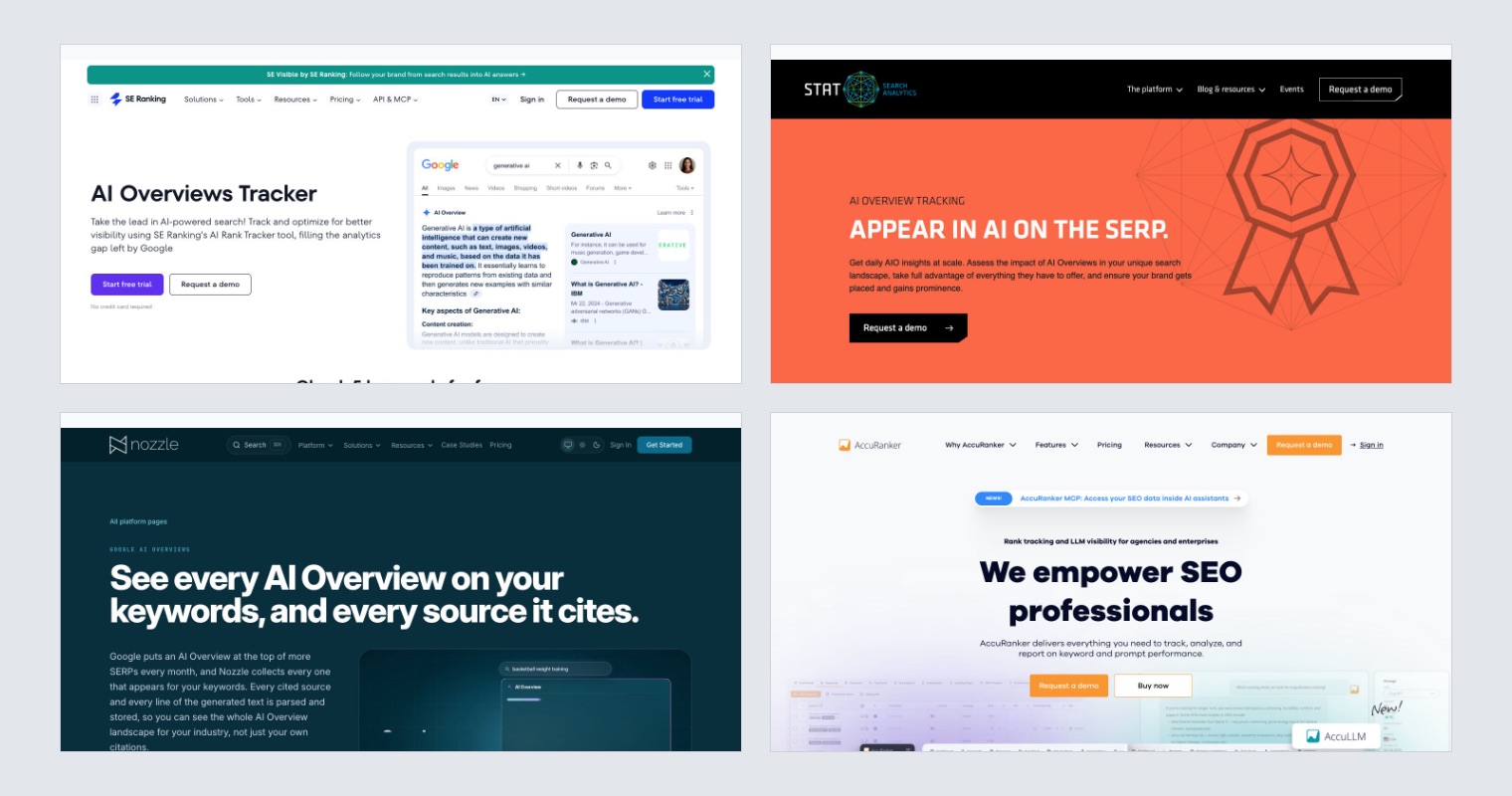
| STAT | STAT provides daily AIO insights, triggering keywords, segmentation by topic, language, location, and device, and full HTML SERP views showing the AIO’s size and copy.[11] | Large-scale SERP observation and segmentation |
| Nozzle | Nozzle parses AIOs in tracked SERPs, records cited-source item rank, stores the SERP and raw HTML, and separates desktop and mobile results across locales.[12] | Source-level AIO evidence and SERP inspection |
| AccuRanker | Its AI Overview page charts tracked keywords with an AIO and owned AIO, shows contributing URLs, and aggregates URLs appearing in AIOs.[13] | Keyword and URL-level AIO summaries |
| SISTRIX | SISTRIX identifies keywords where a domain is cited in an AIO, shows citation rank, and indicates whether the cited URL also ranks organically.[2] | Connecting AIO citations with organic SERP visibility |
Caption: Checked against the research report’s vendor product descriptions on 13 November 2026.
The most useful checklist is whether the tool exposes the AIO trigger, cited URL, citation position, competitors, history, location, and device. STAT and Nozzle emphasize the rendered SERP, while AccuRanker and SISTRIX emphasize keyword and URL summaries.[2][3]
How does Semrush AI Overview tracking work?
Semrush Position Tracking identifies when a tracked keyword produces an AI Overview and whether the tracked site appears in the feature. It supports daily visibility tracking across search engines, locations, devices, and competitors, and allows up to 20 competitors.[6]
That makes Semrush suitable when the reporting unit is a known SEO keyword list. A team can compare AIO presence and visibility changes with conventional ranking data rather than maintaining a separate SERP-monitoring workflow.[10]
Semrush also describes separate AI Visibility features that monitor a custom keyword and prompt set across Google and AI platforms. This creates a distinction within the product family: Position Tracking is the SERP-first workflow, while AI Visibility is the broader prompt and platform layer.[10]
The deciding question is therefore whether the existing Semrush subscription includes the AI capability required for the project. If the brief only requires Google AIO presence and tracked-keyword visibility, Position Tracking may be sufficient; if it requires broader AI-platform coverage, the additional AI Visibility access needs to be checked.
Does SE Ranking track AI Overviews?
SE Ranking’s AIO Tracker reports whether an AIO appears, the site’s position within the feature, competitor sites, and position changes. It supports countries where Google AI Overviews are available and provides API access to AIO metrics and competitor citation data.[10]
SE Ranking also offers an AI Results Tracker that covers Google AI Overviews, Google AI Mode, Gemini, ChatGPT, and Perplexity. Its views include rankings, competitors, and sources, allowing users to examine mentions or links, competitor standing, and influential pages or domains.[14]
This gives SE Ranking a useful middle position between a conventional rank tracker and a broader GEO platform. The AIO Tracker serves keyword-level Google reporting, while the AI Results Tracker addresses a wider set of engines and answer-level signals.[3][10]
What does a dedicated GEO tool add?
A dedicated GEO tool adds monitoring for the answer, not only the Google SERP. It can measure whether a brand is mentioned, which pages or domains are cited, how competitors compare, how the brand is framed, and how visibility changes across prompts, engines, countries, and languages.[1]
| Measurement | Rank-tracker AIO feature | Dedicated or expanded GEO layer |
|---|---|---|
| Starting point | Known Google keyword and rendered SERP[3][5] | Prompt set run through one or more AI engines[1] |
| Primary scope | Google AIO presence and placement[9][15] | Google AIO, AI Mode, ChatGPT, Perplexity, Gemini, Claude, Copilot, or other supported engines[5] |
| Source data | Cited URLs, citation position, SERP HTML, or contributing URLs, depending on the tool[12][3] | Cited pages and domains, source types, citation trends, and source comparisons[1] |
| Brand analysis | Usually limited to presence or position in the feature[7][10] | Mentions, sentiment, framing, share of voice, competitor comparisons, and position[1] |
| Best use | SEO reporting for tracked keywords | Brand visibility, content strategy, reputation, and cross-engine GEO reporting |
Ahrefs Brand Radar, for example, covers Google AI Overviews and AI Mode as well as ChatGPT, Perplexity, Gemini, Copilot, Grok, and Claude. It reports mentions, citations, impressions, and share of voice, with custom prompts and filtering options.[5]
AccuRanker’s AccuLLM similarly extends beyond an AIO SERP dashboard to monitor ChatGPT, Perplexity, AIO, and AI Mode across prompts, with average rank, mentions, cited domains and pages, sentiment, and competitor benchmarks.[16]
1. Finseo — AIO tracking with a broader GEO workflow
Finseo treats Google AI Overviews as a selectable core engine and describes daily prompt tracking by market and language. Its AIO reporting includes brand visibility, mentions, position, competitors, citations, cited URLs and domains, sentiment, source types, country, and local intent.[1] Beyond tracking, Finseo ties visibility to revenue through AI referral analytics from GA4, Piwik PRO or Matomo and survey-based attribution matched to orders. It also turns gaps into prioritized tasks with impact and effort scores and offers content optimization with an AEO score from 0 to 100; attribution, tasks and content tools start at the Business plan. For enterprise teams, Finseo offers SSO via SAML, roles per project, an audit trail and unlimited seats, and it is hosted in Frankfurt, Germany, with EU data residency, GDPR compliance with a data processing agreement (DPA), and ISO 27001 certification, according to its enterprise page.
The model selector also includes Google AI Mode, ChatGPT, Gemini, Perplexity, Claude, Grok, Mistral, DeepSeek, and Microsoft Copilot. Finseo says Google AI Overviews are available on every plan, while the pricing structure allows three models to be tracked in parallel and permits additional models to be booked.[17]
Key features
- Daily Google AI Overview prompt tracking by market and language.[1]
- Visibility, mention, position, share-of-voice, and citation measurements.[18][3]
- Competitor placement and cited-source analysis.
- Sentiment, aspects, and brand framing analysis.[1]
- Google AI Mode and other AI-engine tracking alongside AIO monitoring.[5]
- API, MCP, reports, and broader action workflows described in the product documentation.
Strengths
- It connects AIO monitoring with a broader multi-engine visibility workflow.[9]
- It includes brand-answer context such as sentiment, framing, competitors, and sources.[1]
- It is relevant when the brief includes local markets, languages, or engines beyond Google.[1]
Limitations
- Self-serve brand plans track three models in parallel, so monitoring every available engine requires additional capacity or a higher plan.[17]
- Prompt and monthly-answer allowances vary by plan.
- Pricing starts at EUR 84 per month (about $93) for Starter, or EUR 70 (about $77) per month billed yearly, excluding VAT.[17]
Pricing checked on 13 November 2026
Starter costs EUR 84 per month (about $93), or EUR 70 (about $77) per month billed yearly; Business costs EUR 210 per month (about $231), or EUR 175 (about $193) billed yearly; Growth costs EUR 479 per month (about $528), or EUR 399 (about $439) billed yearly. All prices exclude VAT.[17] Starter includes 50 prompts and 4,500 AI answers per month; Business includes 150 prompts and 13,500 answers; Growth includes 350 prompts and 31,500 answers.[17]
Verdict: Best for teams that need Google AI Overview tracking plus cross-engine visibility, citations, competitors, sentiment, and market-level answer analysis.[1]
2. Semrush — AIO visibility inside a mature rank-tracking workflow
Semrush is a strong fit when the primary task is monitoring AIO presence for an existing keyword set. Position Tracking reports whether a keyword triggers an AIO, whether the site appears, and how visibility changes across locations, devices, search engines, and competitors.[6]
Strengths
- Familiar keyword and position-tracking workflow.
- Daily AIO visibility changes across locations and devices.[6]
- Up to 20 competitors can be added in the Position Tracking workflow.[6]
- Separate AI Visibility features extend monitoring to custom keywords and prompts across Google and AI platforms.[8]
Limitations
- The conventional Position Tracking workflow is centered on tracked keywords and Google SERP conditions.[12][10]
- Broader AI-platform monitoring is described as a separate AI Visibility capability rather than the same basic AIO report.[9]
Verdict: Best for SEO teams that want AIO tracking connected to an established keyword-rank reporting process.[10][8]
3. SE Ranking — AIO and multi-engine AI results in one ecosystem
SE Ranking’s AIO Tracker focuses on Google AI Overview presence, site position, competitors, and position changes. Its separate AI Results Tracker adds Google AI Mode, Gemini, ChatGPT, and Perplexity, with rankings, competitor, and source views.[14]
Strengths
- Combines AIO tracking with broader AI Results monitoring.[4][9]
- Provides competitor and source views beyond a simple AIO-presence flag.[3]
- Offers API access to AIO metrics and competitor citation data.[10]
Limitations
- The AIO Tracker and AI Results Tracker serve different measurement layers, so buyers should confirm which module is included in their subscription.[9]
- Results depend on the selected engines, prompts, countries, and tracking configuration.[8]
Verdict: Best for teams seeking a conventional SEO platform with a clearly separated path from AIO tracking to multi-engine AI-result monitoring.[8][4]
4. Nozzle — SERP evidence and citation-position detail
Nozzle parses AIOs on tracked SERPs and records each cited source’s item rank. It also stores the SERP and raw HTML, separates desktop and mobile results across locales, and groups AIO occurrence by keyword.[12]
Strengths
- Source-level citation and item-position detail.
- Raw SERP and HTML evidence for inspection.[12]
- Desktop, mobile, and locale separation.[12]
- Traffic estimates connected to citation position.[12]
Limitations
- Nozzle’s traffic figure is modeled rather than a direct site-analytics session count.[12]
- Its workflow is tied to SERPs already being tracked, rather than being a general cross-engine brand-monitoring system.[10]
Verdict: Best for SEO teams that need to inspect exactly which source appears in an AIO and where it appears.[5]
5. Ahrefs Brand Radar — Broad AI visibility across engines
Ahrefs Brand Radar monitors AI visibility across a corpus of more than 500 million prompts. It reports brand and competitor share of voice, mentions, citations, and impressions across Google AI Overviews, AI Mode, ChatGPT, Perplexity, Gemini, Copilot, Grok, and Claude.[5]
Strengths
- Broad engine coverage beyond Google AIO.
- Share-of-voice, mention, citation, and impression metrics.[3]
- Custom prompts and filtering options.[2]
Limitations
- AIO Tracker and Brand Radar are separate measurement products with different scopes.[5]
- AI share-of-voice results depend on the selected prompts, platforms, competitors, place, and time.[5][14]
Verdict: Best for teams that need a broad AI-visibility view rather than only keyword-level AIO tracking.[5][15]
How should teams compare AIO and GEO tools?
Use the following criteria before selecting a platform:
- Measurement object: Confirm whether the tool tracks keywords, prompts, rendered SERPs, AI answers, or all four.[5]
- Citation detail: Check whether it exposes cited URLs, domains, source types, citation rank, raw SERP evidence, and historical changes.[1]
- Engine coverage: List the exact engines required, including Google AIO, Google AI Mode, ChatGPT, Perplexity, Gemini, Claude, and Copilot.[5]
- Market scope: Verify country, language, location, and device support rather than assuming global coverage.[11]
- Competitor analysis: Check whether the product reports competitor presence, position, share of voice, cited sources, and head-to-head comparisons.[5]
- Actionability: Look for content gaps, prioritized recommendations, integrations, exports, APIs, or workflows that connect visibility data to work.[18]
The tool should also be evaluated against a fixed monitoring design. Lock the keyword or prompt set, engines, geography, competitors, and review cadence before comparing visibility or share-of-voice results. AI visibility results can change with those choices, so scores from different configurations are not directly comparable.[5]
Which tool is right for whom?
- Google SEO reporting for a known keyword set: Start with Semrush Position Tracking, SE Ranking’s AIO Tracker, AccuRanker, or SISTRIX.[10]
- Detailed AIO source and SERP inspection: Consider Nozzle or STAT.[15][11]
- AIO plus Google AI Mode and other AI engines: Evaluate SE Ranking’s AI Results Tracker, AccuLLM, Ahrefs Brand Radar, or Finseo.[10][5]
- Brand mentions, citations, sentiment, and competitor framing: Use a broader GEO layer such as Finseo, Ahrefs Brand Radar, AccuLLM, or Profound.[3][1]
- AIO monitoring connected to local markets and languages: Check whether the platform supports the required market and language configuration before purchase.[1]
- API, MCP, or reporting workflows: Compare the available API, export, report, and assistant-access features rather than relying on the AIO dashboard alone.[5]
How does AI Overview tracking work in practice?
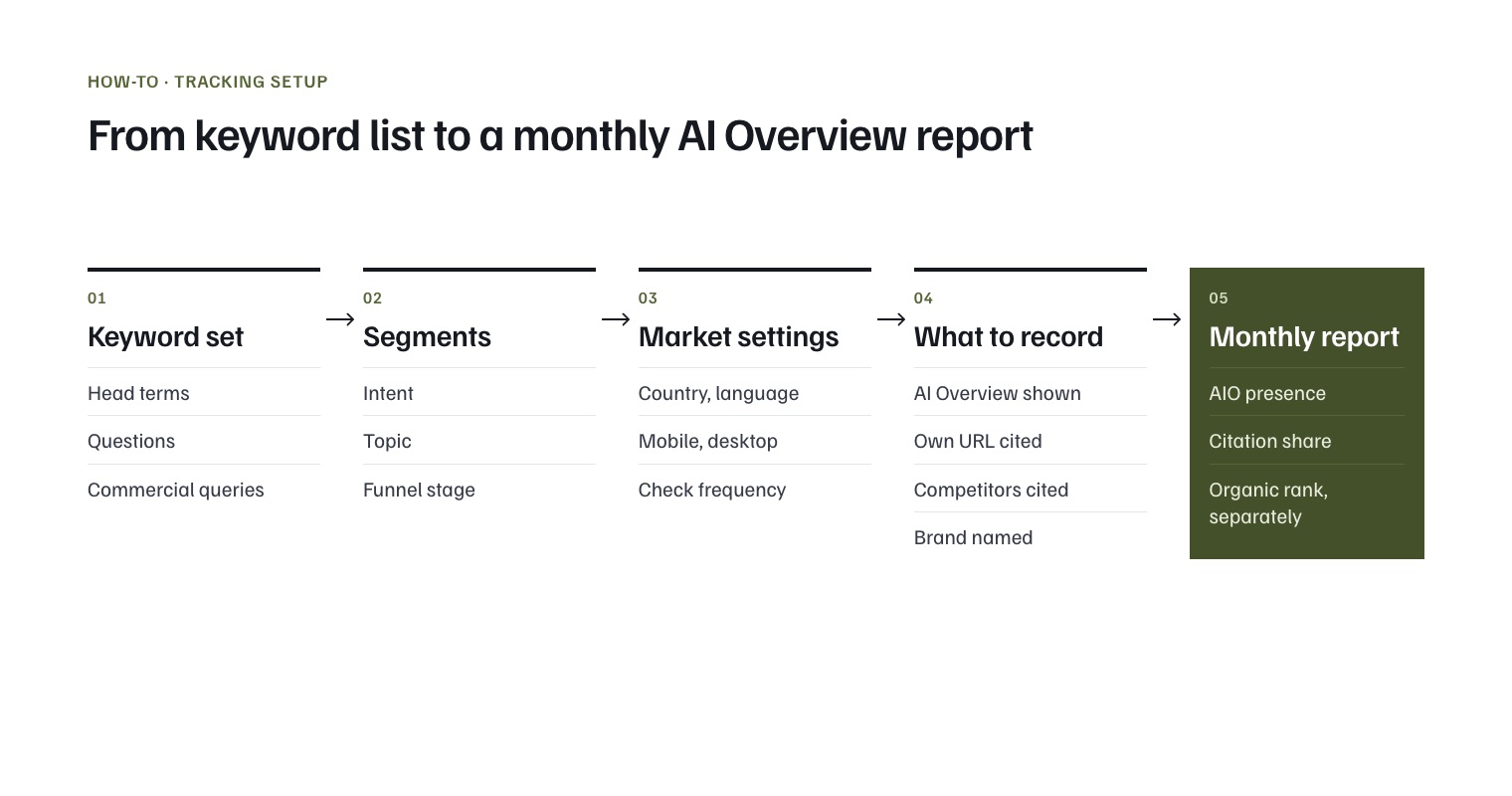
A typical AIO-monitoring workflow has six stages:
- Define the query set. Choose tracked keywords, prompts, competitors, locations, languages, and devices.[6]
- Detect AIO triggers. The platform records which queries produce an AI Overview.[9]
- Read the AIO. It identifies the brand, cited URLs, domains, competitor mentions, and citation or item position where supported.[1]
- Store history. Daily or weekly snapshots show whether AIO presence, brand visibility, or citation position changes over time.[5]
- Compare sources and competitors. Broader tools report competing brands, cited domains, source patterns, sentiment, or share of voice.[5]
- Turn gaps into work. GEO platforms may connect missing coverage or citation opportunities to content recommendations, tasks, reports, or integrations.[18]
The academic GEO research helps explain why these measurements matter: the KDD ’24 paper frames generative-engine optimization as improving content visibility in generative responses and reports visibility gains of up to 40% in its experimental setting.[19] That result is research evidence about content optimization, not a promised improvement from any tracker or GEO vendor.[18] Finseo’s own replication found that the famous 40% GEO lift is rank-dependent: the same edit moved a rank-5 page +115% and a rank-1 page −30%.
What should an AIO tracking export contain?
At minimum, an export should preserve the keyword or prompt, date, engine, country, language, device, AIO presence, owned-domain presence, cited URL, citation or item position, competitors, and the source of the observation. For broader GEO reporting, add mention, sentiment, share of voice, source domain, and prompt configuration.[3]
Frequently asked questions
Is a rank tracker enough to track Google AI Overviews?
Yes, if the requirement is to measure AIO presence and site visibility for a defined Google keyword set. It may not be enough for cross-engine visibility, sentiment, prompt-level brand analysis, or broader citation-source discovery.[7]
What is the difference between AIO tracking and GEO tracking?
AIO tracking generally measures a Google SERP feature for known keywords, including whether the feature appears and whether a tracked site is cited. GEO tracking usually evaluates prompts and AI answers across several engines, with metrics such as mentions, citations, sentiment, competitors, and share of voice.[1]
Does Semrush track AI Overviews?
Semrush Position Tracking identifies keywords that trigger AI Overviews and reports whether the tracked site appears, with daily visibility tracking across locations, devices, search engines, and competitors.[6] Semrush also describes separate AI Visibility features for custom keywords and prompts across Google and AI platforms.[8]
Does SE Ranking track AI Overviews?
Yes. SE Ranking’s AIO Tracker reports AIO presence, site position, competitors, and position changes, while its AI Results Tracker covers Google AI Overviews, AI Mode, Gemini, ChatGPT, and Perplexity.[5][10]
What should an AI Overview tracker show?
At minimum, look for the AIO trigger, owned-domain presence, cited URL, citation or item position, competitor data, historical changes, and the required location and device scope.[11][10] A broader GEO tool should also expose prompts, engines, mentions, sentiment, sources, and share of voice.[1]
When should a company buy a dedicated GEO tool?
Buy one when the business question extends beyond Google SERP visibility to cross-engine brand presence, prompt-level monitoring, competitor framing, sentiment, citation-source discovery, or AI traffic and attribution.[5][1] If the requirement is only Google AIO coverage for tracked SEO keywords, an existing rank tracker may already be sufficient.[4]
Sources
- 1Google AI Overviews Tracker: Citations & Brand Visibility — finseo.ai
- 2AI Overviews: New filter options, in-box AIO analysis available in SISTRIX - SISTRIX — sistrix.com
- 3AI Visibility Metrics | Help Center - Ahrefs — help.ahrefs.com
- 4Choose AI Models to Track — docs.finseo.ai
- 5What is Brand Radar, and how to use it? | Help Center - Ahrefs — help.ahrefs.com
- 6Rank tracking: Track your positions on search | Semrush features — semrush.com
- 7The Complete AEO Platform | Profound — tryprofound.com
- 8Semrush Features for AI Visibility — semrush.com
- 9How to Track AI Overviews: Mentions, Citations, Click Loss, and the Traffic Google Won't Show You — ahrefs.com
- 10AI Overviews Tracker: Advanced Analytics for GenAI Search — seranking.com
- 11AI Overview tracking | STAT Search Analytics — getstat.com
- 12AI Overview Tracking: Every Citation on Every SERP | Nozzle — nozzle.io
- 13AI Overview Page — accuranker.com
- 14What is the AI Results Tracker? – Knowledge Base — help.seranking.com
- 15STAT Knowledge Base | AI Overviews: Now on logged-out SERPs and in… — help.getstat.com
- 16AccuLLM — Track Your Presence in AI Search — AccuRanker — accuranker.com
- 17Pricing, Starter, Business, Growth & Enterprise | Finseo — finseo.ai
- 18Generative Engine Optimization Features | OtterlyAI Platform — otterly.ai
- 19GEO: Generative Engine Optimization | Proceedings of the 30th ACM SIGKDD Conference on Knowledge Discovery and Data Mining — dl.acm.org