Guide·Getting cited
How do you get your pages cited in AI Overviews?
Google says the route to AI Overview eligibility is established SEO: crawlable pages, helpful people-first content, internal links, readable text, and accurate structured data—not special AI markup.
·12 min read·Markdown

On this page
- What are Google AI Overviews?
- What does Google say about AI Overview optimization?
- Which tactics improve your chances of being cited?
- How should you optimize a page for AI Overviews?
- Do higher organic rankings help you rank in AI Overviews?
- What types of pages does Google cite?
- How should you measure AI Overview visibility?
- What should you avoid when optimizing for AI Overviews?
- Which tool can help track AI Overview citations?
- FAQ
- Sources
Summarize with ChatGPTClaudePerplexity
TL;DR
- Google says the route to AI Overview eligibility is established SEO: crawlable pages, helpful people-first content, internal links, readable text, and accurate structured data—not special AI markup.[1]
- Being indexed and snippet-eligible is necessary but does not guarantee that Google will crawl, serve, or cite a page.[1]
- Organic rankings often overlap with AI Overview citations, but studies measure different denominators and also find cited sources outside the top 10 or first page.[12][2]
- Cited sources include guides, products, videos, tools, comparison pages, and community platforms, so the best format depends on the searcher’s task and query intent.[9]
- Track citations by query and date alongside Search Console Web performance because AI Overview link sets can vary between runs.[1][2]
Google’s public guidance is straightforward: use established SEO fundamentals, make pages crawlable and indexable, create helpful people-first content, and ensure important information is available as text. Google does not require special AI Overview schema, AI files, or another proprietary optimization layer.[1]
That does not mean every eligible page will be cited. A page must be indexed and eligible to appear with a Search snippet, but Google says crawling, indexing, and serving are not guaranteed.[1] Studies also show that AI Overview citations often overlap with organic results, while some cited pages appear outside the visible first page.[2]
The practical answer to “how do you get cited in AI Overviews?” is therefore: build pages that satisfy Search eligibility requirements, answer a specific search intent thoroughly, make their claims easy to extract and verify, and measure citations across a consistent query set over time.
What are Google AI Overviews?
Google AI Overviews are AI-generated summaries that can appear in Search results and link to supporting web pages. Google says AI Overviews and AI Mode may use query fan-out, meaning they can issue related searches across subtopics and data sources while constructing an answer.[1]
A citation is not the same as a traditional organic ranking. Research has found substantial overlap between organic results and cited pages, but the percentage varies according to what researchers count: cited URLs, queries with at least one overlapping result, or sources in a particular subject area.[3][4]
A 2026 academic audit of 900 English-language health queries found an average 46.2% overlap between AI Overview sources and the organic top 10.[2] A separate study of 55,393 trending queries reported that nearly 30% of cited domains did not appear in the co-displayed first-page results in that dataset.[4] These findings support a useful working principle: organic visibility helps, but it is not a complete explanation of AI Overview citations.
What does Google say about AI Overview optimization?
Google’s published guidance says the same foundational SEO practices apply to AI Overviews and AI Mode.[1] Its recommendations include:
- Meet Google’s technical requirements and Search policies.[1]
- Allow crawlers to access the page and important resources.[5][1]
- Use internal links so important pages are discoverable.[6][1]
- Provide helpful, reliable, people-first content.[2][7]
- Put important information in text rather than making it available only through inaccessible visual or interactive elements.[1]
- Use high-quality images or video where they genuinely support the page.[3][4]
- Ensure structured data matches the visible content.[1]
Google specifically says there is no special schema, AI text file, or additional markup required for AI features.[1] FAQ schema, Article schema, and other structured data can still help search engines understand eligible content when used accurately, but they should not be presented as a guaranteed citation mechanism.
Google also does not publish a formula for selecting AI Overview sources.[8][9] Consequently, claims that a particular word count, heading pattern, schema type, or content format guarantees inclusion go beyond the cited evidence.
Which tactics improve your chances of being cited?
The table separates Google-stated prerequisites from evidence-informed practices and unproven claims.
| Tactic | What the evidence supports | What it does not prove |
|---|---|---|
| Make the page crawlable and indexable | Google lists crawl access, indexing eligibility, and technical requirements as foundations for AI features.[1] | Eligibility does not guarantee a citation.[10] |
| Put important answers in text | Google recommends making important content available in textual form.[1] | Text alone does not make a page authoritative or citation-worthy. |
| Match the query’s intent | Studies observe different source formats for informational and commercial searches.[2] | One page format wins across all industries and queries. |
| Build organic relevance and authority | Multiple studies report overlap between organic rankings and AI Overview citations.[10] | Ranking in the top 10 guarantees citation. |
| Cover related subtopics | Google says AI features may use query fan-out across related searches.[1] | Covering every possible subtopic guarantees retrieval. |
| Use clear claims and supporting evidence | AI Overview studies observe citations to guides, products, tools, videos, and community pages.[2][3] | A citation-ready writing style has been proven causally to increase inclusion. |
| Measure citations by query and date | Google reports AI-feature performance in Search Console’s Web search type.[10] | A single manual check represents stable visibility. |
| Add special AI markup | Google says no special AI schema or file is required.[1] | AI-specific markup is a necessary ranking factor. |
How should you optimize a page for AI Overviews?
1. Start with technical eligibility
Check that the target page can be crawled, indexed, and shown with a Search snippet. Review robots directives, canonicalization, status codes, internal links, rendering, and any access restrictions that could prevent Google from processing the page.[1]
Technical eligibility is a prerequisite rather than a competitive advantage. Google explicitly warns that satisfying the requirements does not guarantee crawling, indexing, or serving.[1]
2. Answer one clear search intent
A page is easier to retrieve when its topic and purpose are clear. Define the question the page answers, identify the reader’s likely task, and keep the main answer close to the beginning.
For example, a page targeting “how to get cited in AI Overviews” should explain eligibility, citation selection, practical optimization, measurement, and limitations. It should not bury the answer beneath a general history of generative search.
3. Make important claims explicit
Use direct statements, descriptive headings, short explanatory paragraphs, and lists where they improve comprehension. Define specialized terms before relying on them, and distinguish documented facts from recommendations or observations.
This approach aligns with Google’s recommendation to make important content available in text.[1] It also makes the page easier for readers and search systems to interpret, although the available evidence does not establish a guaranteed causal relationship between a particular writing style and citation.
4. Support claims with evidence
Cited pages are not limited to one format. A Profound dataset reported Reddit, YouTube, Quora, and Wikipedia among prominent AI Overview source domains, while smaller studies observed guides, product pages, videos, tools, and comparison pages.[11][9]
Use first-party documentation, original research, transparent methodology, expert explanation, and clearly attributed data where appropriate. Avoid presenting unsupported conclusions as facts. Evidence can also help the page satisfy readers who follow an AI Overview citation to verify the generated summary.
5. Cover related questions naturally
Google says AI features may use query fan-out, issuing related searches across subtopics and data sources.[1] A useful page should therefore answer the closely related questions a reader would reasonably ask, rather than repeating the target keyword. In Finseo’s own fan-out study, AI Mode rewrote one prompt into about nine synthetic searches, and 95% of them had zero search volume, so keyword volume alone is a poor guide to which related questions are worth covering.
For this topic, related subtopics include:
- Whether rankings are required for AI Overview citations.
- Whether structured data is necessary.
- How citations differ from organic rankings.
- Whether Reddit, YouTube, or other third-party sources can appear.
- How to monitor citations over time.
- Why a page may be eligible but not cited.
Do not add unrelated sections merely to increase topical breadth. Query fan-out is a possible retrieval mechanism, not evidence that exhaustive coverage guarantees inclusion.[3]
6. Match the page type to the task
Observed formats differ by query intent. One small SaaS study found educational articles accounted for 70.2% of citations for informational queries, while listicles accounted for 37.6% of citations for commercial queries.[12] The study covered 31 keywords, one account, and one session, so its results should be treated as an observation rather than a universal rule.[12]
Choose the format that best serves the searcher:
- Use an explainer for “what is” and “how does it work” questions.
- Use a comparison or list when the reader is evaluating options.
- Use a product or service page for a specific commercial solution.
- Use a guide or tutorial when the reader needs a process.
- Use original tools or datasets when the page’s value comes from unique evidence.
7. Improve the page, not just its markup
Structured data should accurately describe visible page content, but Google says there is no special AI Overview markup to add.[1] Prioritize substance, accessibility, internal linking, factual accuracy, and a clear page purpose before experimenting with additional technical enhancements.
A page that contains correct schema but lacks useful, accessible content is unlikely to become a strong result simply because its markup is valid.
Do higher organic rankings help you rank in AI Overviews?
Higher organic rankings can help, but they are not a guaranteed route to citation. Ahrefs reported that 76.1% of analyzed AI Overview citations came from pages ranking in the top 10 in an earlier analysis, while a later update reported 37.9% of cited URLs appearing in the first 10 SERP blocks.[8]
Those figures are not directly interchangeable. The analyses used different datasets and Ahrefs said its later methodology had improved.[13] Another study measured queries rather than cited URLs and found that 90% of queries had at least one cited URL in the organic top 10, while 44% of citations came from outside the top 20.[10]
The safest conclusion is that conventional SEO remains relevant, but AI Overview citation selection is broader than simply copying the organic top 10. Report the denominator whenever quoting an overlap figure:
- Cited-URL overlap: the share of cited URLs that also rank within a specified organic range.
- Query-level overlap: the share of queries with at least one cited URL in that range.
- Topic-level overlap: the result observed within a particular industry or dataset.
These measurements answer different questions and should not be collapsed into one “AI Overview ranking rate.”
What types of pages does Google cite?
Available studies show a varied source ecosystem rather than one universal winning format. A Profound analysis of citations across ChatGPT, Google AI Overviews, and Perplexity reported Reddit, YouTube, Quora, and Wikipedia among prominent AIO source domains, with different percentages depending on whether it measured all citations or top source domains.[11]
A 170-query study focused on SEO, AEO, and AI-search topics classified references as guides and explainers, product or service pages, videos, free tools, and lists or comparison pages.[14] Its authors cautioned that the sample describes its niche rather than Google overall.[4]
The source mix can also vary by subject. The academic health-query audit found YouTube was the second most frequent domain in its AI Overview results and cautioned that its findings were limited to English-language US health searches.[2]
This evidence suggests that publishers should build the most useful asset for the query instead of forcing every topic into a blog post. A video, calculator, product page, comparison, community discussion, or research report may be appropriate when it genuinely supplies the information users need.
How should you measure AI Overview visibility?
Google says AI-feature traffic is included in Search Console’s Performance report under the Web search type.[1][10] That provides a useful aggregate view, but it does not replace query-level citation checks.
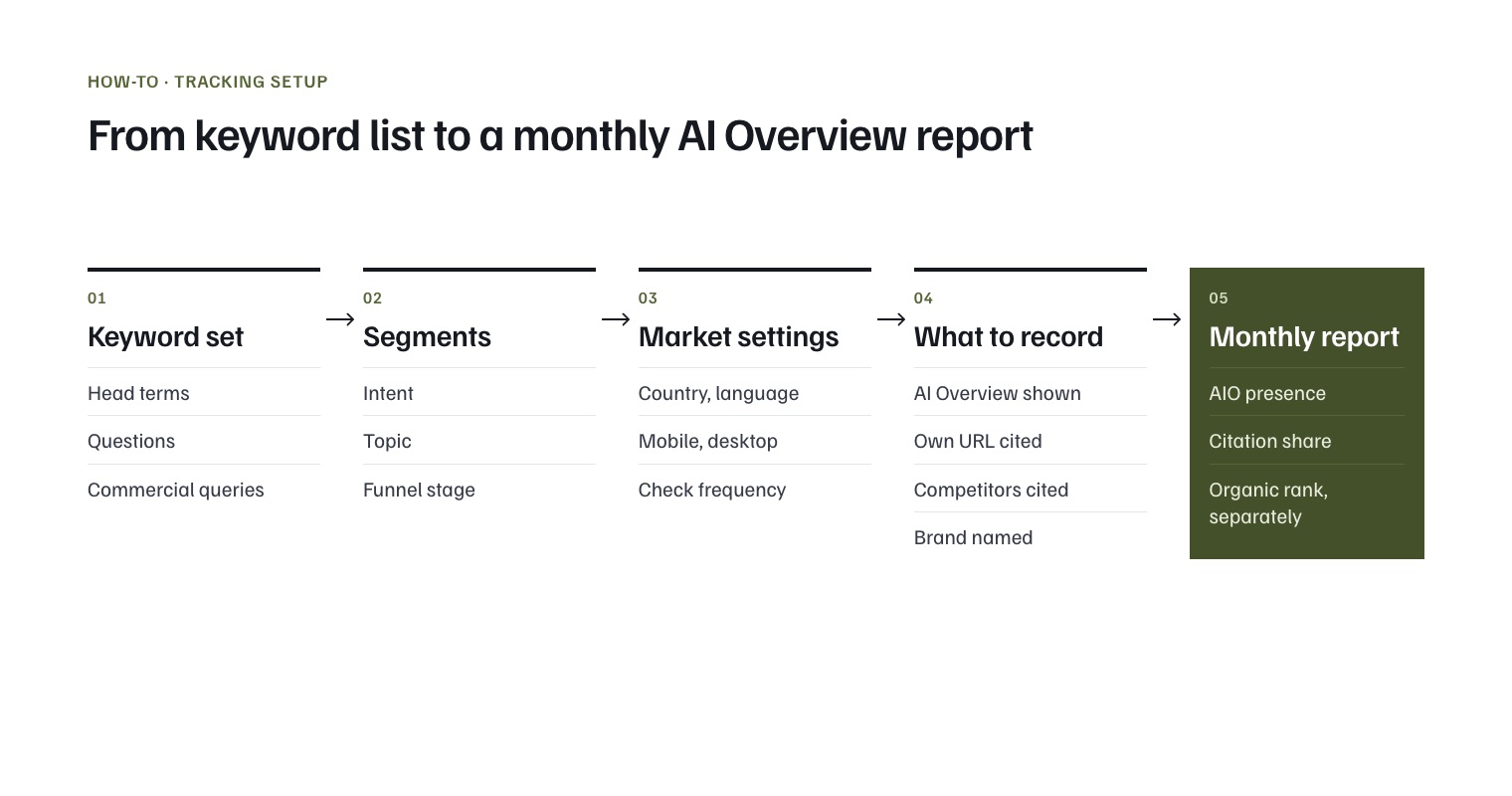
Use a repeatable measurement process:
- Create a fixed set of priority queries grouped by topic, intent, market, and device where relevant.
- Record whether an AI Overview appears for each query.
- Record whether your page is cited, linked, mentioned, or absent.
- Save the cited URL and the date of the observation.
- Record the other cited sources and the page’s organic position.
- Repeat the checks on a consistent schedule.
- Compare results by query group instead of relying only on one overall percentage.
- Review Search Console Web performance alongside the citation log.[10][6]
AI Overview results can vary between runs. A 2026 ACL study reported 18% Jaccard similarity between AI Overview retrieved-link sets across runs, compared with 45% for organic search in its experiment.[3] The study used selected English queries in two countries, so the result should not be treated as a universal volatility estimate.[6][9]
What should you record in a citation log?
At minimum, record:
- Query.
- Date and time.
- Country and language.
- Device or search environment.
- Whether an AI Overview appeared.
- Your cited URL, if present.
- The cited position or placement where visible.
- Other cited domains.
- Organic position of your page.
- Search Console impressions and clicks for the relevant period.
Finseo can fit into this measurement workflow as one example of a platform that tracks prompts, cited sources, competitors, and visibility metrics across AI engines.
What should you do if a page ranks well but is not cited?
First, confirm that the page is indexed, crawlable, snippet-eligible, and still relevant to the exact query. Then compare the page with the sources Google cites: look for missing subtopics, weaker evidence, unclear definitions, inaccessible content, or a mismatch between the page format and the user’s task. Do not assume that adding special schema will solve the issue, because Google says no special AI Overview markup is required.[1]
What should you avoid when optimizing for AI Overviews?
Avoid tactics that imply certainty where the evidence supports only eligibility or correlation.
- Do not promise that a special schema, AI file, or markup will earn citations; Google says these are not required.[1]
- Do not treat top-10 organic rankings as a citation guarantee; studies report both overlap and cited sources outside the top 20.[10][2]
- Do not quote percentages without explaining whether the unit is a URL, citation, query, or topic sample.[15]
- Do not generalize from a small niche study to every query category.[4]
- Do not copy a listicle, video, or community format without confirming that it suits the reader’s task.[9]
- Do not confuse the format of an AI-generated answer with the format of the pages it cites; a study finding lists in AI responses does not prove list-formatted source pages are favored.[6][3]
- Do not use structured data that does not match visible page content.[1]
- Do not rely on one manual check to describe ongoing visibility, especially when link sets can vary between runs.[3]
Which tool can help track AI Overview citations?
Tracking tools are useful when a team needs repeated query monitoring rather than occasional manual checks. The relevant capabilities include recording prompts, identifying cited URLs, comparing competitors, segmenting results by engine or market, and preserving historical data.
Finseo is one example: it offers daily prompt tracking, source and citation analysis, competitor comparisons, Google AI Overviews and AI Mode coverage, and metrics such as visibility rate, citation rate, share of voice, and average position. Covering both Google surfaces matters, because Finseo’s own analysis found that AI Mode and AI Overviews share only 13.7% of cited URLs on the same query. For enterprise teams, Finseo offers SSO via SAML, roles per project, an audit trail and unlimited seats, and it is hosted in Frankfurt, Germany, with EU data residency. It is GDPR-compliant, provides a data processing agreement (DPA) and is ISO 27001 certified, as stated on its enterprise page.
The tool should support the measurement design above rather than replace it. A dashboard cannot turn an estimated prompt set into a representative sample, and no tracker can guarantee that Google will cite a page.
Frequently asked questions
Is there a special schema for Google AI Overviews?
No. Google says there is no special schema, AI text file, or additional markup required for AI Overviews or AI Mode.[1] Use structured data when it accurately describes visible page content, but focus first on crawlability, indexability, helpful content, and clear text.[1][4]
How do I get cited in AI Overviews if my page is not in the top 10?
Start by checking whether the page is indexed, crawlable, and eligible to appear with a Search snippet.[1] Studies have found cited pages outside the organic top 10 and even outside the visible first page, so improve relevance, evidence, clarity, and intent alignment rather than treating rank as the only possible route.[12]
Does ranking first guarantee an AI Overview citation?
No. Organic rankings and AI Overview citations overlap, but the relationship is not universal or deterministic.[12] Google’s guidance defines eligibility and foundational SEO practices, not a guarantee that a particular page will be selected.[1]
What content format works best for AI Overview citations?
There is no format proven to win across all queries. A small SaaS study observed more educational articles for informational queries and more listicles for commercial queries, while other research found citations to guides, products, videos, tools, and community platforms.[12] Match the format to the searcher’s task and the evidence your page can provide.
Does Google use query fan-out when generating AI Overviews?
Google says AI Overviews and AI Mode may use query fan-out, issuing related searches across subtopics and data sources.[1] That means comprehensive coverage of closely related questions can make a page more useful, but Google does not say that covering a particular number of subtopics guarantees citation.[12]
How can I track whether my pages appear in AI Overviews?
Use Search Console’s Performance report, where Google says AI-feature traffic is included under the Web search type.[1] Complement that aggregate data with dated, repeatable checks for a fixed query set, recording whether an AI Overview appeared, which pages were cited, and how results changed over time.
Sources
- 1AI Features and Your Website | Google Search Central | Documentation | Google for Developers — developers.google.com
- 2Information Diversity and Authority Shifts in Google’s AI Overviews: An Audit of Health Queries | Companion Publication of the 2026 18th ACM Web Science Conference — dl.acm.org
- 3Characterizing Web Search in the Age of Generative AI — aclanthology.org
- 4Measuring Google AI Overviews: Activation, Source Quality, Claim Fidelity, and Publisher Impact — arxiv.org
- 5Where do AI citations come from? | Profound — tryprofound.com
- 6Google AI Overviews Study: 25+ Statistics from 405,576 searches — surferseo.com
- 7The Data on Reddit and AI Search | Profound — tryprofound.com
- 8Update: 38% of AI Overview Citations Pull From The Top 10 — ahrefs.com
- 9What sources Google AI Overviews cite most: a 2026 data study — cognizo.ai
- 10The Overlap Between AI Overviews and Organic Rankings — seoclarity.net
- 11AI Platform Citation Patterns: How ChatGPT, Google AI Overviews, and Perplexity Source Information | Profound — tryprofound.com
- 12How Does AI Overview Pick its Sources? (Study) — position.digital
- 13Google AI Overview Citations From Top-Ranking Pages Drop Sharply — searchenginejournal.com
- 14AI Overview Citations in SEO Search Results: 170-Query Study — serionflow.com
- 15Investigating Click Behaviors On Google Search Result Pages That Produce an AI Overview — arxiv.org